The murky graveyard of failed presidential campaigns
Dear Francis,
By now, I am sure, you have seen the news—Donald Trump will once again assume the American presidency. I know you are a bit of a Luddite, preferring dusty tomes to flashy gadgets and the instantaneous delivery of news. That's all for the good, and I admire your commitment to keeping "the clean sea breeze of the centuries blowing through" your mind, as C.S. Lewis once wrote. But you've probably read a newspaper or two since November 5, and I'm sure you've squirreled away a few of your characteristically mordant observations and reactions for me. I can't wait to read them!
As it happens, I have a few for you, as well.
How did Trump win? Conversely, how did Harris lose? This is the question that has engendered a surfeit of both triumphant and bitter commentary since it became clear Trump would secure more than 270 Electoral College votes.
There are competing narratives that try to account for Trump's victory, and especially his gains among most demographic groups.

One perspective of which I am rather dubious is that racism and sexism pushed Trump across the finish line. The argument, as I understand it, is that Harris ran a campaign that was virtually indistinguishable from Joe Biden's in 2020, and yet she ended with fewer votes. See? Racism and sexism. Voters, especially white voters, will back a white man in his dotage but can't be bothered to fall in line for a Black woman, even when our parlous Republic teeters on the brink.
I'm sure you can see the conspicuous flaws in this reasoning, Francis. Harris, who, as the vice president, was inseparable from Biden's administration, ran essentially as an incumbent. When Biden took office in 2021, his approval ratings were positive. Today, they are drowning. Biden's unpopularity acted like a millstone around Harris' neck, pulling her down, down, down to the murky graveyard of failed presidential campaigns.
While I have no doubt that the most flagrant racists and sexists in America backed Trump, I am not convinced those factors explain why Harris lost.
Another voguish explanation, one articulated by U.S. Sen. Bernie Sanders, America's most popular populist, says the Democratic Party failed to run on ambitious progressive economic policies. Sanders said, "It should come as no great surprise that a Democratic Party which has abandoned working class people would find that the working class has abandoned them." Writing in The Nation, Waleed Shahid said: "Despite the noise, voters didn’t reject Harris because of leftist rhetoric or activist slogans. They rejected her because she and her party failed to address the economic pain of working-class voters, who chose change over more of the same."
I find this theory more plausible than the first one I mentioned, Francis. The success certain grassroots campaigns in deep-red states like Idaho saw several years ago when they put Medicaid expansion on the ballot attests to the way in which government programs can transcend partisan politics.
Does this mean that working class voters are economically progressive? Or do they just want to expand a familiar government program, making it work for them? In other words, would a rock-ribbed Republican in Idaho's Trumpiest counties ride the progressive policy train from Medicaid expansion to the Green New Deal—or hop off somewhere after the first stop? While voters in general indicate support for some economically progressive stances, such as higher taxes on the wealthy, their support tends to falter when they hear about the specifics.
The truth, Francis, is that most Americans aren't terribly progressive—something the left struggles to accept. That is especially true for cultural or social topics, such as immigration, law enforcement, religion, some trans issues, abortion, guns, and so on. At best, Democrats pretend working class voters will always prioritize economics over cultural issues at the voting booth when the program or policy in question is especially advantageous to them. At worst, the Ivy League eggheads that dominate leftwing consulting firms and nonprofits can operate as though people's oldfangled convictions are somehow rooted in and a result of their economic circumstances. If the country implemented single-payer healthcare and levied a healthy tax on billionaires, they seem to believe, why, the matronly abuela living on Texas' southern border would surely support gender-affirming care for federally detained undocumented migrants!
As soon as Biden ended his bid for re-election and championed Harris, Harris prudently tacked to the center, where the normies live. Some commentators have seized on this fact to argue that it is risible to claim progressivism sank Harris' campaign. Is it, Francis? In 2019, during her first presidential campaign, Harris giddily reached into the grab bag of progressive positions and pulled one out after the other, like some greedy child on Halloween.
Her eager—and opportunistic—embrace of everything from fracking bans to decriminalizing border crossings provided the Trump campaign in 2024 with a series of easy targets. Harris, who disavowed her erstwhile positions but never explained why, came off as unprincipled—and untrustworthy.
Harris ran to the center but could not escape her past, Francis. And it was the positions she adopted in her first run, not just her convenient repudiation of them when she thought it would help her, that weighed her down in 2024.
As Kevin Drum has noted, Democrats have bounded to the left since the turn of the century.
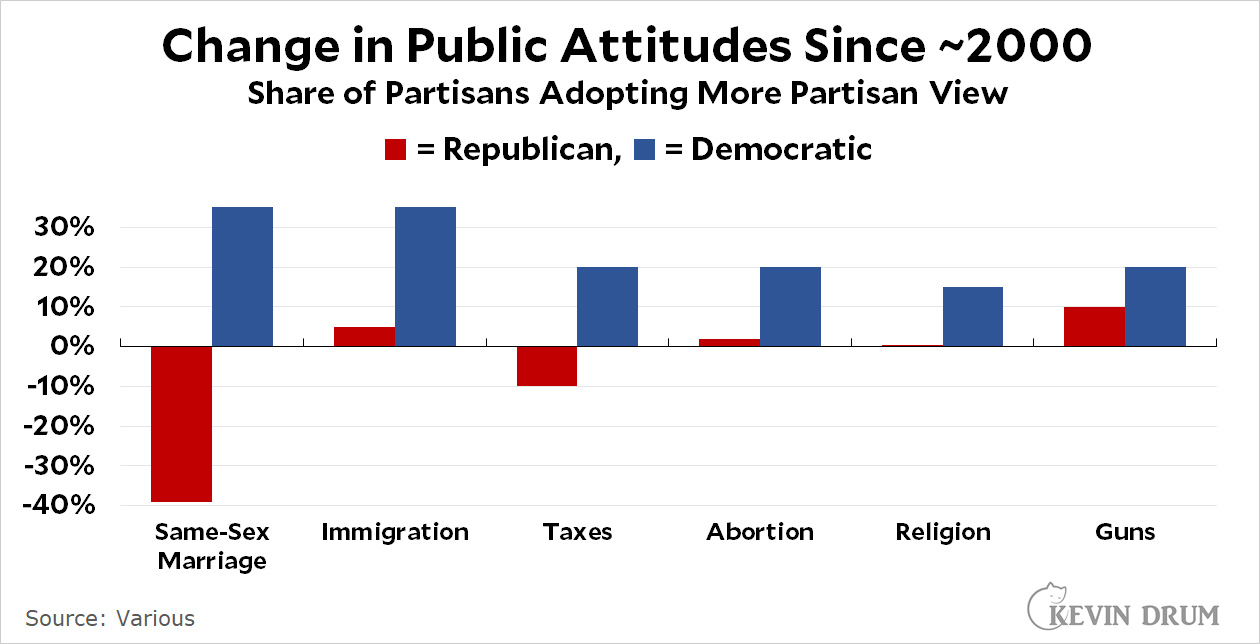
Why? One explanation is that Democrats have become the party of the professional classes—knowledge workers and others in professions that often require advanced degrees. Those professionals get funneled through elite colleges and universities where nearly every professor and administrator holds views far to the left of the average American. They then graduate and work in dense cities around a cluster of other people who also hold deeply progressive convictions. Overwhelmingly, these professionals are white, and they reliably vote Democratic.
At the same time, voters without a college education have drifted toward the Republicans. Those voters hold more conservative beliefs. The Washington Post's Jason Willick wrote, "George H.W. Bush won just 45 percent of Whites without a college degree who voted for one of the two major parties in 1992; Donald Trump won 65 percent in 2020. But Bush won college-educated Whites by four points while Trump lost them by 15 in the two-party vote share."
Somewhat astoundingly, given the dominant narratives around race these days, white, college-educated Democrats tend to hold more progressive beliefs about systemic racism and the fundamental decency of America than people of color.
This realignment means that working class voters who hold conservative or even moderate views on social issues may continue to drift into the Republican fold, turned off by Democrats' pertinacious orthodoxies. Take, for example, the question of gender-affirming care for trans minors, which progressives have chosen to defend with reckless abandon. While most Americans support strong legal protections for trans people in areas like public accommodations and employment, healthy majorities oppose providing trans minors with puberty blockers and cross-sex hormones. This is, perhaps, one reason why one of the Trump's campaigns most effective ads ended with this sassy line: "Kamala is for they/them. President Trump is for you."
If Democrats want to win back working class voters, including the many people of color who are open to considering the GOP, they will need to figure out where they are willing to compromise on social issues. Perhaps, after many hard conversations, they will decide they aren't willing to abandon vulnerable trans teens or identify a gestational limit on abortion—even if it means they lose elections. That would be a principled stance, and one many would find admirable (albeit shortsighted, perhaps).
Democrats are taking the wrong lesson from 2024 if they believe they can ignore social and cultural issues and focus only on economics. But for Democrats, Francis, taking the wrong lesson has become an occupational hazard.
I am looking forward to your thoughts!
With love,
SEW